This is an account of our recent holiday to Chile, Bolivia and Peru.
So what did we think of South America? At various times during our trip we suffered from, among other things, illness, pickpockets, psychotic van drivers, Andean panpipes, strikes, blockades and dynamite. In short, we had a great time. The above isn’t much of an exaggeration as we managed to pack a great deal on incident into our three and a half weeks away. We even managed to do a bit of sightseeing.
The trip logically enough started at Wellington airport where we were due to catch a flight up to Auckland and then another one from there to Santiago in Chile. We duly arrived at the check-in desk only to be informed that we were not on the manifest of either of the flights. We had booked the flights through Qantas but the actual carriers used were Air New Zealand and LAN Chile. It turned out that Qantas hadn’t registered us onto the above airlines databases. Nice one Qantas. It was all eventually sorted out, but was nevertheless and inauspicious start to the trip.
We landed at Santiago airport without further incident and from there caught a bus into town. The usual thing from here is to book into a hostel or cheap hotel. This process normally takes us no more than 20 minutes, but we couldn’t find any accommodation anywhere and this was right in the heart of the city. Eventually, after about an hour and a half of sweat and toil dragging ourselves and our backpacks around Neena managed to find the Santiago Backpackers hostel which is situated in a good location on a side street about 10 minutes’ walk from the main square (Plaza de Armas). The hostel itself was basic, but reasonably priced with the added bonus of free breakfast and cheerful friendly staff.
Our search for accommodation took us through the smartest and indeed main shopping area in Santiago. During this time we must have walked past a hundred restaurants and eateries with absolutely every one of them offering what was to become the ubiquitous pollo and frites (also hotdogs in Chile’s case). pollo and frites in english is chicken and chips and is by far and away the most popular dish in all the countries we visited; you sure as hell wouldn’t want to be a chicken in South America.
A little aside here from much later on in the trip when Neena got ill and LAN were kind enough to put us up free of charge in the 5-star Hilton hotel with breakfast, lunch and dinner thrown in. Neena wasn’t well, but I decided to help myself to their set lunch. The main course when it arrived was beautifully presented in exquisite surroundings, but you guessed it, was basically chicken and chips! Food wise this pretty well summed up South America for me in that you come here for the scenery and culture and emphatically not the cuisine. I will add that were some very tasty exceptions to this rule, but I shall come to them later.
We only had one day in Santiago before flying off to La Paz in Bolivia and it’s fair to say that neither of us, on first acquaintance, was that impressed. It funny that when we revisited the city three weeks later and in a different state of mind we both absolutely loved the place.
It felt great to finally arrive in La Paz as for me this represented the true start of the holiday, given that Bolivia and Peru were the real targets of this trip. The city centre was colourful, lively and chaotic with terrible traffic congestion and not a little noisy as the local drivers used their horns at every available opportunity. This was great stuff and I decided that I really liked the place. The centre of La Paz is situated at the not inconsiderable altitude of 3500m, so the plan for the first few days was just to get acclimatised, see some sights and basically take things nice and easy.
This is pretty typical of La Paz
I had heard that many people initially suffer from shortness of breath in La Paz. I did find this to a degree, but only when walking up some of the city’s steeper streets. What I am prone to is headaches and migraines so was expecting trouble on this front. This indeed what happened as I endured 4 days and nights of constant headaches and nausea before things finally sorted themselves out. This was despite taking every kind of pain killer I could lay my hands on - during this period I would gladly have got back on a plane and gone home. To be honest I suspect that it may have been the sun rather than the altitude that was the route of the problem. At this height the temperature isn’t that high, but the sun is deceptively powerful as at this latitude it is almost overhead. I started to religiously wear my sun hat, drink lots of fluids and lo and behold started to feel a lot better.
On a positive note we did stumble on a lovely café that sold some splendid cakes (at this stage a small amount of cake is about all I could bring myself to eat) and which became our “local” whenever we were in La Paz. Cakes are something the Bolivians love and do very well. Despite trying lots of different places it is reassuring to have somewhere nice and familiar to fall back on.
While walking around on our second day in La Paz we couldn’t help but notice that there were very large numbers of mostly guy’s milling around the streets wearing safety helmets and also a lot of police officers wearing bullet proof vests and riot gear. There didn’t initially seem to be any great order to things so we naively assumed this was all pretty normal, particularly in this part of the world. Eventually I became clear, that even for Bolivia, this wasn’t at all normal and that we had stumbled on what was to become a very serious protest march by striking miners and their families.
The march once it started was quite a spectacle as there must have been ten’s of thousands of miners who were often accompanied by their wives who were dressed in the wonderfully eccentric national dress that consists of brightly coloured skirts, shawls and bowler hats! The men were constantly letting off firecrackers, which were very noisy indeed but nothing compared with the huge booms that rang out every few minutes and which literally shook buildings and ones internal organs. It sounded like war had broken out, which wasn’t so far off the truth as we learnt later that the miners had been letting off dynamite, and not very well at that, as unfortunately, one of them managed to blow themselves up. I am not sure what the miner’s issues with the government were but they certainly meant business as they blockaded the main routes out of the La Paz for the next two day’s. This meant that we stayed two days longer in the city than planned which wasn’t so bad as it gave Neena and I some extra shopping and sightseeing time, and for me specifically, some time to get over the headaches. Bolivian miners have to put up with some of the harshest conditions in the world, so despite the inconvenience to us, my sympathies were very much with them.

This one was taken at the large square near our hostel a little before the miners march got going.
Whilst in La Paz we took a bus tour of the city and the nearby “Valley of the Moon”. The valley was given its name by Neil Armstrong who thought it looked similar to, you guessed it, the moon. I couldn’t quite see it myself, but will have to defer to Neil on that one. It was an interesting excursion all the same not least because our guide gave us an entertaining potted history of Bolivia, which certainly added some context to what we had seen over the previous few days. The countries military and political history was fascinating. Not least, as until recent times, they were effectively one and the same thing; three presidents in a day and two at the same time etc.
The Mountains of the Moon.
Fascinating as the above was, we were both mightily relieved to finally make it onto a bus heading for the town of Copacabana, which is situated on the shores of Lake Titicaca.
The bus journey didn’t look far on the map, but distances can be pretty deceptive in this part of the world, and in the end it took us around 5 hours. An hour or so from Copacabana the road abruptly ended at a small village on the edge of a lake. From here we had to get off the bus and take a short ferry ride before resuming our journey. The ferry was very small but all 30 or so passengers made it on alright. I couldn’t see any larger boats around so assumed that we would be met by a bus on the other side of the lake, not that I could see any. Looking back over the lake I was amazed to see our bus heading towards us perched precariously on a tiny boat, which looked ready to sink at any moment. This was most entertaining and I could well understand why we travelled separately from the bus.
I am jolly glad we weren't on this.
We arrived at Copacabana with something of a dilemma. We had a number of “must do” things on this trip and due to the miners strike were already well behind schedule, so we made the reluctant decision to spend only the afternoon there and then take an overnight bus up to Cusco in Peru.
We booked a trip on a boat to the Island of the Sun. I am a sucker for a boat trip and this was a nice way to see at least some of Lake Titicaca and its surroundings.
The Lake is situated at the heady height of 3800m and is absolutely massive and far larger than I expected it be; more like a sea really. It is surrounded by many spectacular snow capped Andean peaks. These would have been even more spectacular were it not for the ever present haze which partially obscured them. The haze was present at all times on our trip to South America and is I assume a seasonal thing as when Neena visited this area some years ago in the middle of winter she says the skies were crystal clear.
The Island of the Sun is very nice and on another longer trip we would doubtless have stayed there, but Cusco beckoned, and it was the bus for us.
On the way to the Island of the Sun.
There were many snow capped peaks surrounding Lake Titicaca.
We arrived at the bus station in Cusco at about 6am feeling absolutely shattered. It was pretty early, but there were plenty of people about and within seconds we were accosted by a women offering us accommodation for a bargain 60 Sols (NZD$25) a night with the added bonus of a free taxi ride thrown in. We had no real idea where the hotel was situated, but in instances like this we tend to go with the flow and agreed there and then.
The Hotel Samanapata was tucked away in a quite, atmospheric back street about 10 minutes walk from the centre of town, was clean, with nice rooms and had free WIFI so could hardly have been any better.
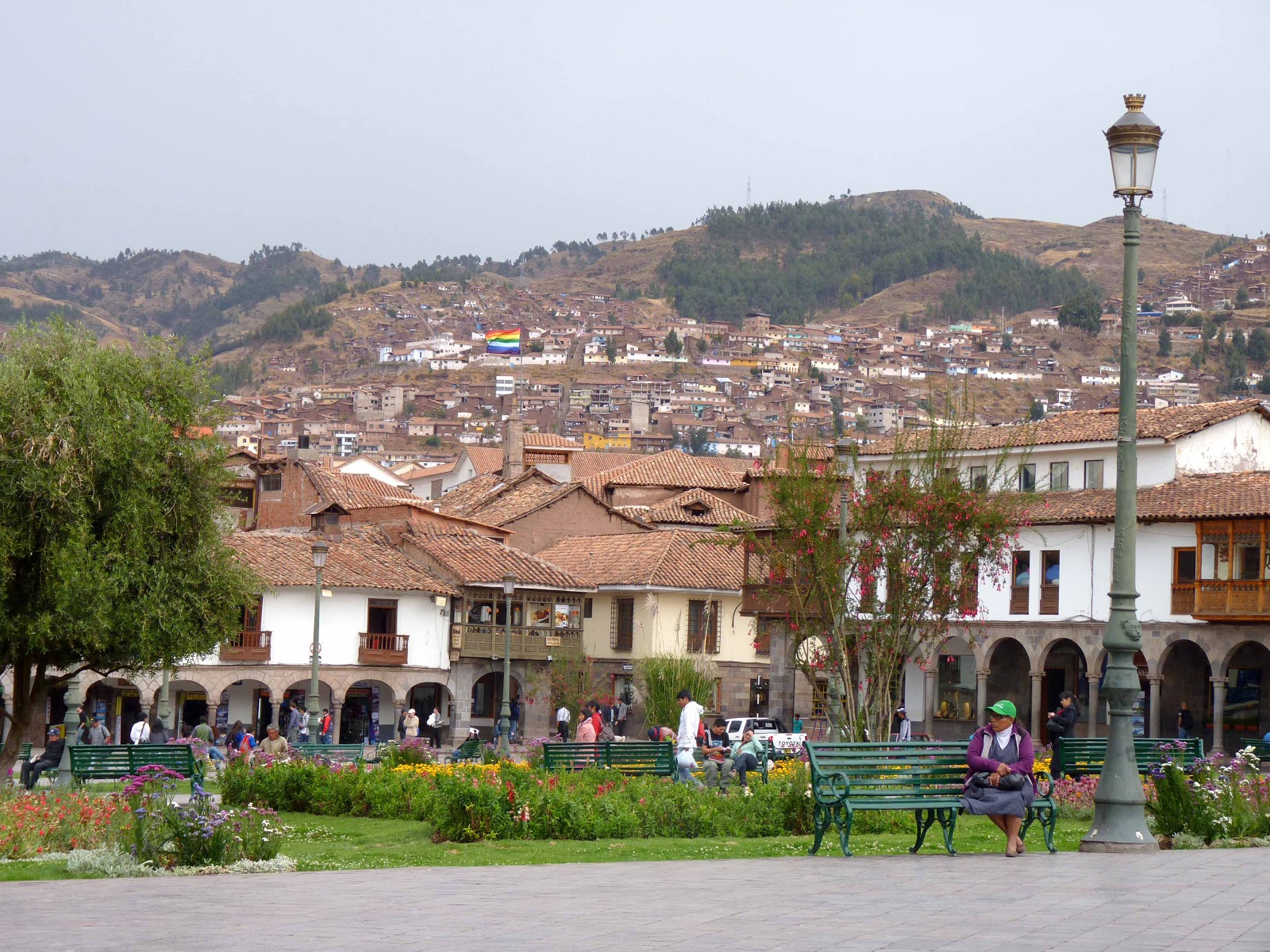
The centre of Cusco is very agreeable with a large main square and many attractive Spanish colonial buildings. The city as a whole has a nice open and chilled out feel and is much less frenetic and noisy than La Paz.
We spent our first day in Cusco just walking around checking out the sites and local cafes as well as pondering what to do next.
The main square.
Cusco at Night.
Neena has been to this part of South America before, having spent 3 months here a few years ago and has consequently seen most of the main attractions. We therefore decided to visit somewhere that neither of us had been to before and settled on a 4-day trip to the Manu National park situated in the Peruvian jungle.
The trip wasn’t due to start for 2 days so we also booked ourselves onto a 1-day tour of the nearby Sacred Valley of the Incas. The tour consisted of visiting ancient Inca sites at Pisac, Ollantaytambo and Chinchero all of which had different characters and all impressive in their own ways. For me the trip would have been even more enjoyable if we had had an English speaking guide, as without some kind of history and context the ruins can sometimes seem like just a bunch of rocks. Neena disagrees with me on this and feels that they also had a spiritual quality, which alas I did not feel.
The Inca ruins at Pisac.
English is little spoken in this part of the world even in some of the main tourist areas. I was going to take a basic Spanish course before I came over but chickened out mostly due to the cost. In retrospect this was a mistake, as I would have got a lot more out of South America in general with some understanding of the language. This is something I will rectify next time around - sometimes the time honoured British tradition of shouting and pointing is not enough!
It was possible to eat incredibly cheaply in Cusco providing you stuck to the fixed menus at the local restaurants. These tended to consist of three courses consisting of soup, a main and a drink and could be had for as little as 10 Sols (NZD$2). For the most part the food was pretty bland, but it is difficult to quibble at these kinds of prices. On the culinary front the highlights were a local cocktail called a Pisco Sour and quite possibly the best chocolate cake I have ever had anywhere which was served up at the very non local but very good Jack’s Bar. On the debit side, we had Llama on a number of occasions, which wasn’t horrible, but tasted pretty much what imagined a Llama would taste like i.e. a funny looking sheep.
Early the next day we set off for the jungle in a small minivan accompanied by two Swiss girls, a French couple, our driver and our guide.
The journey to the jungle involved us climbing up well in excess of 4000m over the Andes and then dropping down several vertical miles the other side. For the most part the road was little more than a badly maintained and bumpy dirt track with the added bonus of precipitous drops and certain death if we got too near the edge. It took 12 bone shaking hours to get there but was well worth it for the spectacular scenery and wildlife we saw en-route.
It was interesting to see how the landscape changed from being dry and arid on the western side of the Andes to lush rainforest on the eastern side and all of this within a few short kilometres.
On the way down into the jungle we stopped for lunch in an area of Cloud Forest situated at around the 3000m mark. The Peruvian national bird, the Andean Cock-of-the-rock (honest), lives in this part of the forest and our guide led us on what was initially a fruitless search to find them. We could hear them, but not see them, which was very frustrating. Our guide informed us that the best viewing area was owned by a rival company and was strictly out of bounds. He however carried out a quick reconnaissance mission, found that there was no one around, had a quick think about it, and decided to go in anyway. The Cocks-of-the-rock’s are wonderfully colourful birds and were fascinating to watch, so well worth the risk.
The Cock-of-the-rock.
We had a few other stops to photograph monkeys and butterflies among other things.
A Monkey.
Looking down on the jungle.
All this meant that it was well dark by the time we reached our lodge for the night. This proved interesting as the lodge was located on the other side of a rather large and angry sounding river and could only be accessed by sitting in a cage which was suspended above it and then pulled across by hand. This was most exciting as the whole thing was carried out in the pitch black dark (there is no power available in this part of the jungle).
The lodge was in a lovely setting, not that we got to see much of it, as we had a long day ahead of us so next morning it was straight back to the minivan. The basic plan for the day was to travel to a nearby village and then catch a boat that would take us onto another lodge where we would be based for the next two nights.
Our room for the night.
And this is how we got there.
On the way we stopped off to visit a small sanctuary for rescued and orphaned animals. This part of the day was pretty unheralded and low key, but turned out be a magical experience, and for both of us was the highlight of the whole trip.
The animals are not caged and there are no fences so they are free to come and go as they please. They were all reasonably tame and approachable and seemed to get on with each other as well. The highlights for me were a Spider Monkey and a Sloth both of which were impossibly cute. Refreshingly there was no hassle for any kind of financial contribution, not that any was needed.
Spider Monkey.
An impossibly cute Sloth.
An impossibly cute Parrot.
Neena looking a little nervous.
Me doing my Best Long John Silver impression.
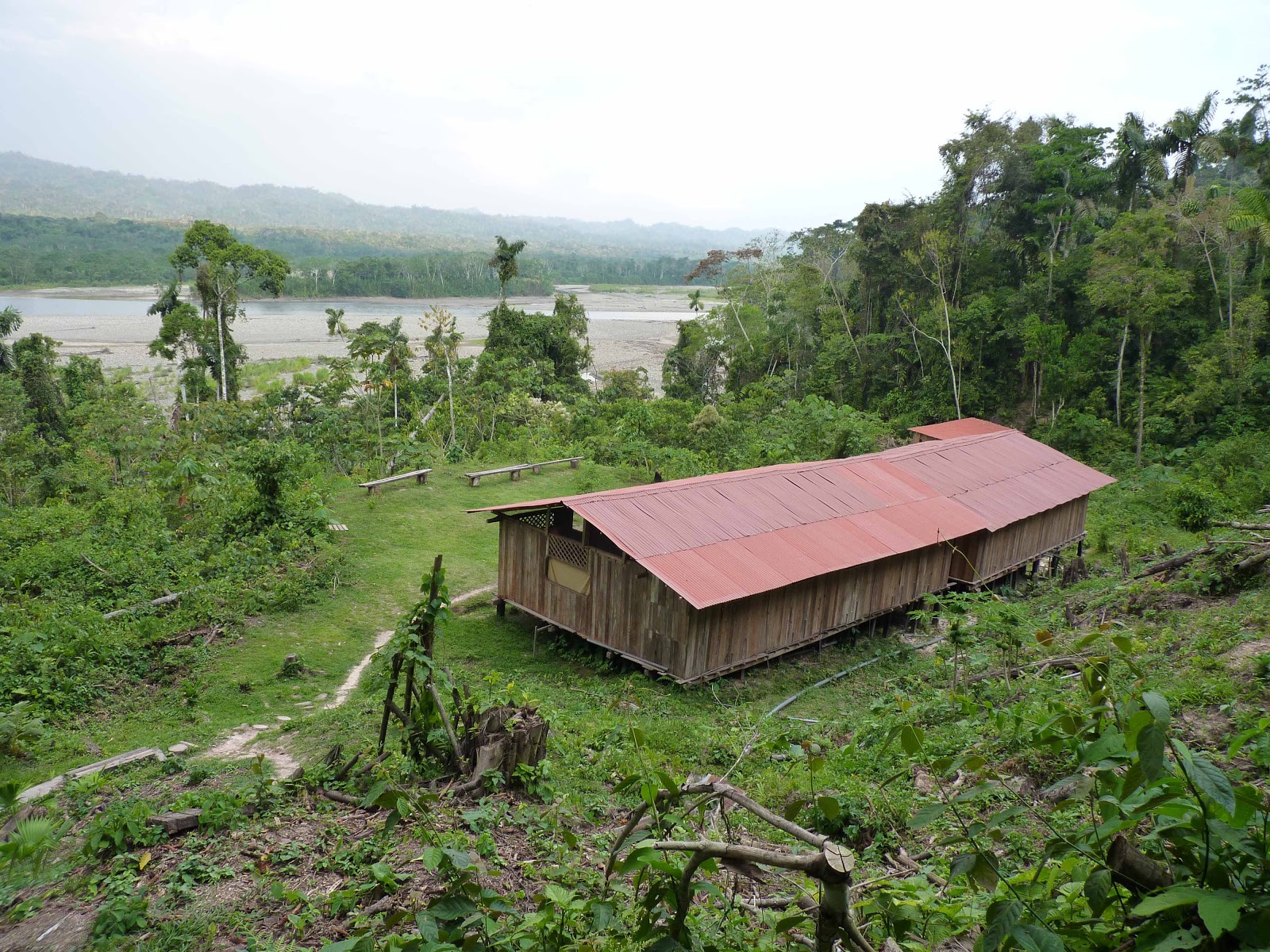
After the sanctuary it was onto the boat for the trip to the lodge. The river was large and powerful with some minor rapids so Neena in particular was relieved when we were all issued with life jackets. The boat trip was fast and fun, but all too brief as we arrived at the drop off point to the lodge after 20 minutes or so. From here there was a similar length walk along the riverbed and up through the jungle to the Lodge itself. The boat was to be our transport for the next two days during which time the life jackets were nowhere to be seen; I think they were just for show as there plenty of officials checking over the boats in the village.
This was our mode of transportation for the next couple of days.
Our Lodge.
We relaxed for the rest of the afternoon at the Lodge and then set off on a night trek through the jungle. The jungle at night really comes alive. There were all sorts of noises coming from its various inhabitants and also a pretty good light show from the many fireflies. We were supposed to be looking out for monkeys. We didn’t see any of these, but we did see a great many fearsome looking insects including a particularly large and nasty looking scorpion spider. Yuck!
Wild jungle women.
The night’s excitement wasn’t quite over for me. Later in the evening I was walking outside close to our room when there were several loud “cracks”. This sort of thing tends to give you the collywobbles particularly when it is pitch black and your imagination is in overdrive. Our guide also heard the noise which he said was caused by a Whip Snake when it feels threatened, so it must have been very close. We spent a fair bit of time looking for the snake, without any luck.
We set off on the boat at first light the next day in order to see the Manu Clay Lick which is a large gathering of thousands of red-and-green Macaws. The birds roost overnight by a large cliff and then take off early in the morning to forage for food. We had breakfast by the river which was all very nice. The bird watching itself, for me at least, was a bit of a let-down as the Macaws must have been at least a mile away and even with my camera, which has an 18X zoom, they looked minute. If you ever do find yourself watching the Manu Clay Lick then my tip is to get hold of a very large zoom (and a tripod) or failing that, be prepared to use your imagination.
After the Clay Lick it was off on the boat again to visit an Ox-Bow Lake. This was much more like it. The lake is situated in an area of regenerating bush, was really beautiful and full of birds you could actually see! We spent quite a few hours walking around this area before heading back to the Lodge.
The climate in the jungle had so far been surprisingly comfortable with temperatures probably in the mid 20’s coupled with relatively low humidity, which is evidently due to the close proximity of the Andes. During the trip back to the lodge however the clouds started to build up and the temperature and humidity really started to climb and quickly became uncomfortable. The jungle had been pretty benign so far but this gave us an inkling of how demanding the environment could be, particularly during the forthcoming rainy season.
Back at the Lodge, we were treated to a huge thunderstorm which was thankfully situated a couple of kilometres away on the other side of the river. We were due to go on another night tramp but we were all knackered after the day’s exertions and the heat, and in the end only the French couple were brave enough to go.
We headed off the next day on the long journey back to Cusco. I wouldn’t normally mention anything about this, but the antics of our driver will stick in the mind for a long time.
As I said earlier, the road back is pretty rough and in many parts certainly not for the feint hearted. Three or four hours into the journey one of the Swiss girls must have been feeling a bit nervous and suggested to our driver that he was looking a little tired and might care to take a short break. I am sure this was said with the best of intentions, but the driver’s machismo must have taken a bit of a hit as for the next 20 minutes we were taken on a real horror ride with him driving like an absolute lunatic. Thankfully we were all in one piece after this, which is more than could be said for the van, which was a tad battered and missing a rear shock absorber, which had snapped clean off.
I will say in the driver’s defence, that as unprofessional as he was, he was superb with Neena and helped her out a great deal on our treks, which she found rather difficult.
The result of all this was an even more uncomfortable ride back, some seriously pissed off passengers and a poor ending to what had been a really nice trip.
We got back to Cusco fairly late and checked in for another night at the Hotel Samanapata. We didn’t waste any time the next day and took a local bus to Ollantaytambo and from there caught a train to Aguas Calientes with the aim of visiting Mach Pichu (Lost City of the Incas) the next day.
The train ride was expensive but well worth it for the stunning views. The train winds its way up an ever-narrowing valley with high mountains towering above it before arriving at Aguas Calientes after a couple of hours.
The town itself is pretty and is again situated in a rather lovely setting, but to me lacked any real charm as these days it is wholly given over to serving tourists like us, who are visiting Mach Pichu. Prices here were in general high, but true to form we found a cheap hostel and then set about booking tickets for the bus to Mach Pichu and entry to the site itself.
A couple of tips here. Make sure you book your tickets before hand as they are not sold at the site itself and also try to catch the earliest bus (about 6am, but worth the pain) so you can to avoid the crowds that quickly build up. If you have the time and inclination you can walk from the town to Machu Pichu which is around 8km away up the steep road and save yourself the even steeper $17 fare.
I won’t mention too much about Machu Pichu other than to say that it is not considered one of the wonders of the world for nothing. Even being the cynical bugger that I am, I have to say that its reputation is justified. It is perched in the most dramatic and precarious location imaginable and is a sight to behold.
Even better than Harlow town park...
Another nice view.
We lingered as long as we could, before catching the bus and then the train back to Ollantaytambo, where we stayed the night. We spent the morning checking out the town and then caught a bus, which took us back to Cusco.
The constant travelling was fun but also hard work so when we arrived back in Cusco we decided to have a couple of days off and take things easy.
Before leaving the city I decided I had had enough of the quite life and somehow managed to convince Neena to go on a white water rafting trip with me. I have been rafting many times over the years including trips at grade-5 (the top of the commercial scale) and get a tremendous buzz out of the whole experience. Neena is pretty risk averse and had never been rafting before so we booked onto what we were assured was a nice and easy grade-2 trip.
The rafting rivers I have been on typically have sections of rapids interspersed with quitter sections. Not this one, which consisted of 2 hours of pretty well continuous rapids most of which were nearer grade-3 with a few a bit above that. Not quite as advertised - no surprises there then, but all part of the fun. Neena was distinctly nervous at the start, but quickly got into the spirit of things and did just fine.
After all that excitement, we headed back to La Paz on an overnight bus. These buses have comfortable reclining seats and are popular with travellers, and while they are not particularly cheap, they are a great way to maximise ones sightseeing time and also save on a night’s accommodation.
Back in La Paz it was decision time. We had 4 days before we flew back to Santiago and way to many things that we wanted to do, so something had to give. My number one aim on this trip was to visit the Uyuni. This area is a surreal, alien looking landscape containing the largest salt flat in the world, along with volcanoes, geysers and other natural wonders. I remember seeing pictures of this area when I was young and have always wanted to go there. The trouble was that it was at least another 12-hour bus ride away and 3 or 4 days are needed to see the area properly. We could have done yet another series of marathon bus rides and at least seen some of the place, but reluctantly made the decision to leave it for another trip and do it properly.
This left us with plenty of time to kill in La Paz and got me thinking about some very interesting alternatives. Interesting to me anyway.
Neena wanted to visit some more historical sites and hit the shops. Neither of these options particularly appealed to me, so the solution was for her to do her thing for a couple days while I visited a place called Chacaltaya and then cycled “The World’s Most Dangerous Road”.
Chacaltaya is only about an hours drive from La Paz, and at a height of 5486m, used to be the worlds highest ski resort. I say used to, as just a couple of years ago its glacier melted away putting an end to any skiing. I used to ski regularly when I was living in the UK (something I rarely do in NZ) so have known about the place for a long time, but didn’t think I would ever get a chance to get there. This turned out to be pretty easy as I booked onto a small bus with a few other backpackers and off we went.
The final 20 minutes of the journey were pretty “hairy” with the usual big drops, and was most entertaining. At the start of the trip I suffered horribly with the altitude so I was more than a little nervous, particularly as reaching the actual summit involves a hike up another 200m or so. I needn’t have worried, as I was probably the quickest in my group despite them being about half my age; it is amazing what three weeks of acclimatisation at altitude can do. I could certainly feel the effects of the thin air and the cold but not as badly as I thought I would.
The ski lodge. We had to walk from here.
Sadly, this is about all that is left of the glacier.
The views from the top were not at all bad.
The glacier may have gone (there are still a few tiny patches of ice) but Chacaltaya was still an awesome place to visit as it afforded fantastic views of the surrounding peaks many of which are mercifully still snow capped. Much as I love travelling and experiencing new cultures and cities, landscapes and in particular mountains are my real love, so I was well pleased.
We had another day of leisure in La Paz during which time I booked the cycle trip for the next day and managed to get my wallet pinched!
I have only really got myself to blame for the wallet, which I normally leave back in NZ. My usual system when travelling is to have all my valuables in a concealed body belt with just a small amount of “day money” in my pockets. For reasons even I don’t understand, I brought the wallet along with me this time and got used to using it.
As is our want, we were in a crowded local market away from the main tourist areas when 3 or 4 people jostled me and someone squirted some kind of black liquid into my ear. This startled me (which I guess was the idea) and I turned around to see what idiot had done this and in an instant the wallet was gone. I realised just a few seconds later by which time it was all too late. I only lost about NZ$40, but it was a pain cancelling my various cards and even more of a pain informing the local “tourist police”. Funnily enough none of the local tourist police could speak a word of English and the whole interview was done “in mime”. Marcel Marceau would have been proud! Oh well.
The next day was our last full day in La Paz before we flew off to Santiago and a good time to ride The World’s Most Dangerous Road (The Death Road). This is a bit of a misnomer these days as pretty all traffic now uses a nice and safe bypass leaving the original road largely to adrenalin fuelled tourists such as myself.
The North Yungas Road as it is properly known used to kill an estimated 200 – 300 people a year so its reputation is not without foundation. The roads is 69km long and drops from 4700m up in the Andes before ending up at about 1100m in the jungle. It is narrow for much of its length with vertical drop-offs of hundreds of metres or more and in places barely wider than your average truck. This wouldn’t have been so bad had the road been one way, which alas it was not.
There are lots of companies in La Paz who operate cycle tours, so it’s just a case of paying your money and off you go. Everything is thrown in including a guide, mountain bikes, riding gear, food and transport.
The tour started in a very civilised fashion with breakfast at a local hostel and then it was off in our support van to the start high up in the Andes.
We were given a safety briefing which really boiled down to take it slowly going round the corners and don’t go to near the edge and you will be just fine. All that’s left was to take a few photos and we were off.
The first 20km are on the bypass and were fast and exhilarating as we hits speeds of 70km/hr or more at times. After this it was onto the Death Road proper. The road was unpaved and bumpy which was actually a bit of a shock after the smooth fast tarmac we had been on so far.
I do a bit of mountain biking, so from this perspective the road actually isn’t particularly narrow and as the group got a feel for things, the speed went up and up and I can honestly say that no one overtook us all day.
This was exhilarating stuff, though we all remembered what we had been instructed and took it easy on the bends and the more dangerous sections. I suspect that we would have gone a good deal slower if we could have seen the numerous huge drops but we couldn’t as much of the track was cloudy and misty.
A quick footnote here. It has been about 4 years since any tourists have died but with a disproportionate number of the 30 or so who have done have been Israeli’s!
Less than 4 hours after starting we arrived at the finish in the jungle. Such was the level of concentration and commitment involved that that the time taken seemed far less than that.
After a nice lunch and a spot of sunbathing it was on the bus back to La Paz. The trip had one surprise left as it started raining on the climb back up the Andes and then the rain turned to snow. An unexpected and fun way to end the trip.
Dropping down through the cloud forest.
Not far from the jungle and about 20 degrees warmer.
The Death Road was a great experience. Providing you can ride a bike and are moderately adventurous you should have no problems.
We flew out to Santiago the next day and stayed at the Santiago Backpackers again. This left another day for sightseeing before flying back to NZ. As mentioned earlier, this was not without incident, so many thanks to LAN Chile for helping us out, and no thanks at all to Air New Zealand who most certainly did not.
Overall this was a great trip, if a tad challenging at times due to us trying to fit too much into to short a space of time. We intend to do a longer trip to South America in 2 years time and are planning to visit Uyuni and then southern Chile.
Over and out From Neena and Michael